Category: National

  • India’s FIU Issues Notices to 25 Offshore Crypto Exchanges Over AML Non-Compliance

    India’s FIU Issues Notices to 25 Offshore Crypto Exchanges Over AML Non-Compliance

    India’s FIU Issues Notices to 25 Offshore Crypto Exchanges Over AML Non-Compliance

    Report by:  Syed Taskin Ahmed 

    New Delhi, October 2, 2025 — India’s Financial Intelligence Unit (FIU-IND) has issued show-cause notices to 25 offshore cryptocurrency exchanges for failing to comply with the country’s anti–money laundering regulations under the Prevention of Money Laundering Act (PMLA), 2002.

    According to officials, these exchanges have been offering services to Indian users without registering with the FIU and without adhering to Know Your Customer (KYC), transaction monitoring, and record-keeping norms mandated since March 2023.

    Major Platforms Under Scrutiny

    Among those flagged are some well-known global platforms including BingX, LBank, CEX.IO, CoinEx, Paxful, and BitMex.

    If they fail to comply, authorities may block their websites and mobile apps in India, effectively cutting off access for Indian traders.

    Regulatory Push

    India extended PMLA provisions to cover Virtual Digital Asset Service Providers (VDA SPs) in March 2023, making it mandatory for crypto exchanges to follow anti–money laundering obligations similar to banks and financial institutions.

    The FIU’s move is being seen as part of the government’s broader push to bring greater transparency and security to the rapidly growing digital assets sector.

    What It Means for Investors

    Indian crypto users may soon face restrictions in accessing non-compliant offshore platforms. Experts suggest shifting to registered and FIU-compliant exchanges operating within India to avoid disruptions in trading and withdrawals.

  • US Proposes Tax on Outsourcing: Potential Double Blow for Indian IT Industry

    US Proposes Tax on Outsourcing: Potential Double Blow for Indian IT Industry

    US Proposes Tax on Outsourcing: Potential Double Blow for Indian IT Industry

    Report by: Syed Taskin Ahmed

    The Indian IT sector, already reeling from the recent $100,000 H-1B visa petition fee, may face another setback as the United States considers imposing a new tax on outsourcing.

    Under the proposed “HIRE Act”, American companies that outsource jobs to countries like India could be subjected to additional taxation. The legislation aims to discourage U.S. firms from moving employment opportunities overseas, encouraging more onshore hiring.

    If implemented, the move is expected to have a significant impact on Indian IT giants such as Infosys, TCS, Wipro, and HCL, which derive a large share of their revenue from U.S. contracts. Analysts warn that this could lead to increased costs for U.S. tech companies and reduced competitiveness for Indian service providers.

    Industry body NASSCOM has expressed concern, calling the combined effect of the H-1B visa fee hike and the outsourcing tax proposal a “double blow” for the $250 billion Indian IT industry.

    The timing of these policy shifts has raised uncertainty across the sector, with experts noting that both measures—if enforced—could accelerate the trend of U.S. companies setting up offshore development centers outside India or automating more processes to cut costs.

  • India Launches ₹100 Crore Scheme to Boost Green Hydrogen Startups

    India Launches ₹100 Crore Scheme to Boost Green Hydrogen Startups

    India Launches ₹100 Crore Scheme to Boost Green Hydrogen Startups

    Report by: Syed Taskin Ahmed 

    New Delhi, Sept 13 – In a major push toward clean energy and innovation, the Government of India has rolled out a ₹100 crore funding scheme exclusively designed for startups working in the green hydrogen ecosystem.

    📌 Key Highlights of the Scheme:

    Total Budget: ₹100 crore allocated for innovation in hydrogen technology.

    Grant Size: Each startup or project can avail up to ₹5 crore in funding support.

    Focus Areas:

    Green hydrogen production and storage technologies

    Electrolyzer manufacturing and scaling

    Hydrogen Valley projects

    National Goal: To position India as a global Green Hydrogen Hub and achieve 5 million tonnes of annual production capacity by 2030.

    🚀 Growing Tech Startup Momentum

    The funding boost comes at a time when India’s startup ecosystem is witnessing robust activity across multiple technology verticals:

    Fintech: Digital payments and lending startups continue to attract heavy investor interest.

    AI & Space Tech: Artificial Intelligence and space innovation companies are gaining traction among venture capital firms.

    Sustainability & Clean Tech: Green hydrogen, renewable energy, and climate-tech startups are emerging as priority sectors for both government and private investors.

    🌍 Broader Impact

    The scheme is expected to accelerate India’s journey to Net Zero by 2070, reducing dependence on fossil fuels.

    By offering early-stage financial support, the government aims to de-risk innovation and help startups bring cutting-edge technologies to the market faster.

    This move is also seen as India’s effort to establish itself as a global leader in clean energy innovation.

    📢 In essence, this funding initiative is a significant step toward aligning India’s technology-driven startup ecosystem with the nation’s long-term climate and energy goals.

  • 🏥 Indian Hospitals to Boost IT Innovation Spending by 20–25%

    🏥 Indian Hospitals to Boost IT Innovation Spending by 20–25%

    🏥 Indian Hospitals to Boost IT Innovation Spending by 20–25%

    Report by: Syed Taskin Ahmed 

    New Delhi, Sept 12: India’s healthcare sector is on the brink of a significant digital transformation. Hospitals across the country are preparing to raise their IT and digital innovation budgets by 20–25% over the next two to three years, aiming to integrate cutting-edge technologies that improve efficiency, patient outcomes, and overall care delivery.

    📈 Why Hospitals Are Increasing IT Spend

    The rising burden of chronic diseases, higher patient volumes, and demand for advanced care are pushing hospitals to turn toward technology-driven solutions. Industry insiders say the increased investment is not merely about modernizing hospital operations but also about building resilience, scalability, and patient-centric systems.

    According to an EY India report, over 70% of Indian hospitals have already begun digital adoption initiatives, with priority areas including automation, telemedicine, electronic health records (EHR), and AI-driven diagnostics.

    ⚙️ Areas of Investment

    Automation: Hospitals plan to automate routine tasks such as billing, discharge summaries, lab reporting, and inventory management. This reduces administrative burden, minimizes errors, and frees up medical staff for critical care.

    AI and Data Analytics: By analyzing patient histories, imaging data, and predictive models, doctors can provide faster and more accurate diagnoses. AI tools can also assist in identifying early signs of diseases like cancer or cardiac issues.

    Telemedicine and Remote Care: The pandemic accelerated adoption of teleconsultations, and hospitals are now investing further in virtual care platforms to reach rural and semi-urban areas where medical infrastructure is limited.

    IoT-enabled Devices: Wearable monitors and smart sensors are being introduced to provide real-time patient data, helping doctors track recovery and adjust treatments proactively.

    👩‍⚕️ Impact on Patients and Doctors

    For patients, the upcoming transformation means shorter waiting times, seamless online appointment booking, better transparency in billing, and personalized care plans. Real-time access to health data will also empower patients to take more control of their health.

    For doctors and hospital staff, digitization means faster access to complete medical histories, reduced paperwork, and AI-powered decision support tools that enhance treatment precision.

    🌐 Wider Implications

    Healthcare analysts believe that this 20–25% hike in digital budgets will not only improve hospital efficiency but also:

    Strengthen medical research through big-data insights.

    Improve public health management by enabling hospitals to share data with government health networks.

    Boost India’s health-tech startup ecosystem, as hospitals will increasingly collaborate with local tech firms to implement solutions.

    💬 Expert View

    “India’s hospitals are entering a decisive phase where technology is no longer optional but essential,” said Dr. Ritu Anand, a healthcare technology consultant. “Investments in AI, telemedicine, and IoT will shape the next decade of patient care, making healthcare more predictive, preventive, and personalized.”

    📊 The Road Ahead

    With the government also promoting Digital Health Mission initiatives, experts expect India’s healthcare IT market to grow at over 20% CAGR by 2030. As hospitals push forward with innovation, the sector is poised to set new benchmarks in accessibility, efficiency, and quality of care.

  • Starlink to Begin Internet Trials in India, Holds Talks with Jio, Airtel, and Tata Communications

    Starlink to Begin Internet Trials in India, Holds Talks with Jio, Airtel, and Tata Communications

    Starlink to Begin Internet Trials in India, Holds Talks with Jio, Airtel, and Tata Communications

    Report by: Syed Taskin Ahmed

    Elon Musk’s satellite broadband company, Starlink, is preparing to begin trials in India, marking a major step toward expanding satellite-based internet services in one of the world’s largest digital markets. According to reports, the company is in advanced discussions with Reliance Jio, Bharti Airtel, Tata Communications, and several data center operators to finalize partnerships for infrastructure and service rollout.

    The focus of these talks is primarily on ground infrastructure, licensing clarity, and partnership models. While Starlink could provide services directly, bundling with existing telecom players is also being explored to ensure seamless distribution and regulatory compliance.

    Starlink’s entry could prove transformative for India’s rural and remote regions, where over 500 million people still lack reliable internet access. Traditional fiber networks and 5G rollout have struggled to reach challenging terrains such as the North-East, Ladakh, and the Andaman & Nicobar Islands. In such areas, Starlink’s Low Earth Orbit (LEO) satellites can deliver high-speed broadband without the need for extensive physical infrastructure.

    Globally, Starlink has demonstrated speeds of 100–250 Mbps with latency as low as 20–40 milliseconds, making it suitable for video streaming, online education, remote work, and even defense operations. However, affordability remains a challenge: the current hardware kit costs around $599 (₹50,000) with a monthly subscription of $120 (₹10,000). To succeed in India, Starlink may need to offer localized pricing.

    Competition is also heating up. Airtel-backed OneWeb is already working on satellite broadband services, while Jio and Amazon’s Project Kuiper are also eyeing the sector. Additionally, Starlink must overcome regulatory hurdles, as the Department of Telecommunications (DoT) previously halted its pre-booking plans in 2021.

    If approvals are granted, Starlink could begin pilot trials in late 2025, initially targeting rural, hilly, and disaster-prone regions. Its success will depend on government clearance, partnerships, and affordable pricing strategies, but the move signals a potentially disruptive shift in India’s digital connectivity landscape.

  • SBI Digital Banking Services Face Temporary Outage on September 7

    SBI Digital Banking Services Face Temporary Outage on September 7

    SBI Digital Banking Services Face Temporary Outage on September 7

    Report by: Syed Taskin Ahmed

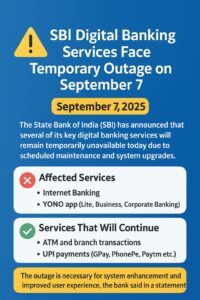
    New Delhi, September 7, 2025 — The State Bank of India (SBI), the country’s largest public sector lender, has announced that several of its key digital banking services will remain temporarily unavailable today due to scheduled maintenance and system upgrades.

    According to an official notification, customers may face disruptions while accessing internet banking, YONO Lite, YONO Business, and Corporate Banking platforms. The bank clarified that this outage is necessary to strengthen its digital infrastructure and ensure more secure and efficient services in the future.

    > “We regret the inconvenience caused to our valued customers. The downtime is essential for system enhancement and improved user experience,” the bank said in a statement.

    Services to Remain Functional

    While online platforms will be affected, SBI ATMs and branch services will remain fully operational. Customers can continue to perform cash withdrawals, deposits, and other branch-based transactions without disruption.

    In addition, UPI payments through third-party apps such as Google Pay, PhonePe, and Paytm are expected to function normally, though some linked services may experience brief delays.

    Advice for Customers

    SBI has advised its customers to plan their transactions accordingly and use alternative channels such as ATMs or branch banking for urgent requirements. The bank has also urged users to stay updated through official announcements on its website and verified social media handles.

    Growing Digital Footprint

    SBI’s YONO app and internet banking services cater to millions of customers daily, handling transactions worth several crores. The temporary outage underscores the challenges large financial institutions face in balancing service availability with the need for robust security and system resilience.

    This maintenance exercise comes at a time when digital banking adoption in India is witnessing exponential growth, making uninterrupted service a top priority for both banks and customers alike.

  • Mumbai: First Delivery of Tesla Model Y from City’s First Outlet

    Mumbai: First Delivery of Tesla Model Y from City’s First Outlet

    Mumbai: First Delivery of Tesla Model Y from City’s First Outlet

    Report by: Syed Taskin Ahmed

    Mumbai witnessed a historic moment in India’s automobile industry as Tesla delivered its first Model Y SUV from its newly inaugurated showroom at Bandra-Kurla Complex (BKC). This marks the company’s first official customer handover in the country, further solidifying Tesla’s entry into the Indian electric vehicle (EV) market.

    The delivery event took place just weeks after Tesla launched its flagship Experience Centre in Mumbai on July 15, 2025. Maharashtra Chief Minister Devendra Fadnavis had earlier inaugurated the showroom, emphasizing the state’s vision for sustainable mobility. Now, with the first Model Y officially on Indian roads, Tesla has moved from showcase to delivery, turning anticipation into reality for its customers.

    The Model Y, Tesla’s best-selling electric SUV globally, is available in two variants in India:

    Rear-Wheel Drive (RWD) priced at around ₹60 lakh.

    Long Range All-Wheel Drive (AWD) priced at around ₹68 lakh.

    The car offers impressive driving range, cutting-edge autopilot features, and Tesla’s signature minimalist interior design.

    Tesla also announced that its first batch of deliveries will be limited but will gradually expand over the coming months. Industry experts believe that this initial delivery signals the beginning of Tesla’s larger rollout strategy in India, which includes expanding sales, service networks, and charging infrastructure.

    To support its customers, Tesla is setting up Supercharger stations in Mumbai and Delhi-NCR, with more cities to follow. This move is expected to significantly boost EV adoption in India, offering a reliable charging ecosystem to Tesla owners.

    With its first customer delivery complete, Tesla has officially begun its journey on Indian roads. The milestone is not just about one car but about setting the tone for the future of luxury EV mobility in the country.

  • 9 Carat Gold Now Included Under BIS Hallmark Certification

    9 Carat Gold Now Included Under BIS Hallmark Certification

    9 Carat Gold Now Included Under BIS Hallmark Certification

    Report by: Syed Taskin Ahmed

    A major update for gold buyers in India— the Bureau of Indian Standards (BIS) has officially brought 9 Carat Gold under the ambit of Hallmark Certification.

    Until now, hallmarking was limited to 14K, 18K, 22K, and 24K gold. With this new decision, even 9 Carat Gold, which contains 37.5% purity, will now carry the BIS hallmark.

    Experts believe this move will bring greater transparency and trust to the jewellery market. It will particularly benefit buyers looking for budget-friendly gold jewellery, as they can now enjoy the same government-backed guarantee of purity that higher carat gold already offers.

    India is among the world’s largest consumers of gold, and the jewellery sector continues to expand rapidly. In such a scenario, the inclusion of 9 Carat Gold under hallmarking is being seen as a significant step towards consumer protection and industry standardization.

    According to industry insiders, this move will not only strengthen consumer confidence but also give a positive push to the jewellery business by making it more reliable and transparent.

  • Indian Muslim Groups Decry ‘Heinous Massacre’ of Tourists in Near Pahalgam

    Indian Muslim Groups Decry ‘Heinous Massacre’ of Tourists in Near Pahalgam

    New Delhi: Several Indian Muslim organisations have condemned the ‘heinous terrorist targeting’ of tourists near Pahalgam in Kashmir, and have called for severe punishment to the perpetrators. They also called upon all Indians, irrespective of religion, to display communal amity, as shown by ordinary people of Kashmir.

    In a statement, the Indian Muslims for Secular Democracy (IMSD), along with the Bebaak Collective, Bharatiya Muslim Mahila Andolan, Centre for Study of Society and Secularism, Citizens for Justice and Peace and Wisdom Foundation, has alsio demanded a thorough probe into such a “grave security lapse”.

    “The terror attack hits at the heart of the Valley’s tourism centre, Pahalgam, putting a big question mark on claims of “return of normalcy”. The latest mass killing raises disturbing questions about the failure of security agencies in ensuring adequate cover in and around Pahalgam, among the obvious targets of terrorist groups. We demand a thorough enquiry into such a grievous security lapse, fixing of responsibility and necessary action,” read the statement, issued by Javed Anand of IMSD.

    Read the full statement below:

    Press statement

    Indian Muslims condemn the heinous massacre of tourists near Pahalgam, Kashmir

    Indian Muslims for Secular Democracy (IMSD), along with the Bebaak Collective, Bharatiya Muslim Mahila Andolan (BMMA), Centre for Study of Society and Secularism (CSSS), Citizens for Justice and Peace (CJP) and Wisdom Foundation strongly condemns the heinous terrorist targeting of tourists near Pahalgam in the Kashmir valley, killing 26 innocents and injuring several others on April 22.

    We join all fellow Indians in offering our heartfelt condolences to the family and friends of the deceased. And call upon the central and state governments to ensure urgent and adequate compensation for the loss of precious lives and proper treatment of the injured.

    According to some reports, The Resistance Front (TRF), a shadow group of the banned Pakistan-based Lashkar-e-Taiba (LeT) terror group, has claimed responsibility for the strike.

    We hope that the perpetrators are swiftly apprehended, brought to justice and handed severe punishments.

    IMSD has always opposed any targeting of innocent civilians anywhere, irrespective of the cause offered as justification for such savagery.

    The terror attack hits at the heart of the Valley’s tourism centre, Pahalgam, putting a big question mark on claims of “return of normalcy”.

    The latest mass killing raises disturbing questions about the failure of security agencies in ensuring adequate cover in and around Pahalgam, among the obvious targets of terrorist groups.

    We demand a thorough enquiry into such a grievous security lapse, fixing of responsibility and necessary action.

    Meanwhile, in this moment of grief and anguish, we are heartened by the humanity displayed by the average Kashmiri Muslim. On Wednesday (April 23) the entire Valley observed a complete bandh: shopkeepers, traders, transporters. Reports across Kashmir of Mosques opening their doors to assist distraught tourists are pouring in as are reports of open condemnations from the Mosques calling this terror attack an attack on humanity itself.

    Kashmiri newspapers have in their editorials and front pages, editorially and visually conveyed the message that this is a day of mourning for the lives lost. IMSD urges all media, especially the television channels to objectively report the developments and not slide into any provocative coverage.

    We call upon all Indians irrespective of religion to emulate the fine example of communal amity displayed by ordinary Kashmiri Muslims.

    Signatories:

    Javed Anand, Convenor, IMSD [9870402556]

    Hasina Khan, Bebaak Collective

    Irfan Engineer, Director, Centre for Study of Society and Secularism (CSSS)

    Teesta Setalvad, Citizens for Justice and Peace (CJP)

    Zakia Soman, Co-Convenor, Bharatiya Muslim Mahila Andolan (BMMA)

    Zeenat Shaukatali, Director General, Wisdom Foundation

  • ‘Supreme’ hearing on Wakf law: Status quo will remain till the next date

    ‘Supreme’ hearing on Wakf law: Status quo will remain till the next date

    ‘Supreme’ hearing on Wakf law: Status quo will remain till the next date

    The Supreme Court on Thursday heard the petitions filed regarding the Waqf (Amendment) Act, 2025. A bench of Chief Justice Sanjiv Khanna, Justice Sanjay Kumar and Justice KV Vishwanathan gave the government seven days to file a reply on the demand of the Center. The government also assured that till the next hearing, ‘Waqf on behalf of the user’ or ‘Waqf on behalf of the documents’ properties will not be denotified. The Chief Justice said that if any Waqf property is registered under the 1995 Act, then those properties cannot be denotified till the next hearing on May 5. After this, the court fixed May 5 as the next date of the case. Solicitor General Tushar Mehta, appearing on behalf of the government, said that the government is accountable to the people. The government got lakhs of representatives, included in Waqf in every village. Waqf is claimed on so many lands. It is considered a part of the law. On the opinion of interim stay, Mehta said that staying the law would be a harsh step. He sought a week’s time to file a preliminary reply with some documents before the court. The Solicitor General assured that there will be no appointment of the board or council during this period. He also said that this is not a matter which can be considered in this manner.

    The Supreme Court clarified, the court had said that there are some positive things in the law and it cannot be completely stopped. It does not want any change in the current situation. The court said that when the matter is pending in the court, we have to ensure that there is no change in the current situation.
    The Supreme Court took on record the statement of the Solicitor General that the Center will respond within seven days. The Supreme Court said that the Solicitor General assured the court that no appointment will be made in the council and board. The court said that the Solicitor General assured that till the next hearing date, the Waqf, which includes the Waqf-by-user already registered or declared through notification, will neither be denotified nor will the Collector take any decision regarding it. The Supreme Court said that the Center should file a reply within seven days. Till then the status quo will remain.