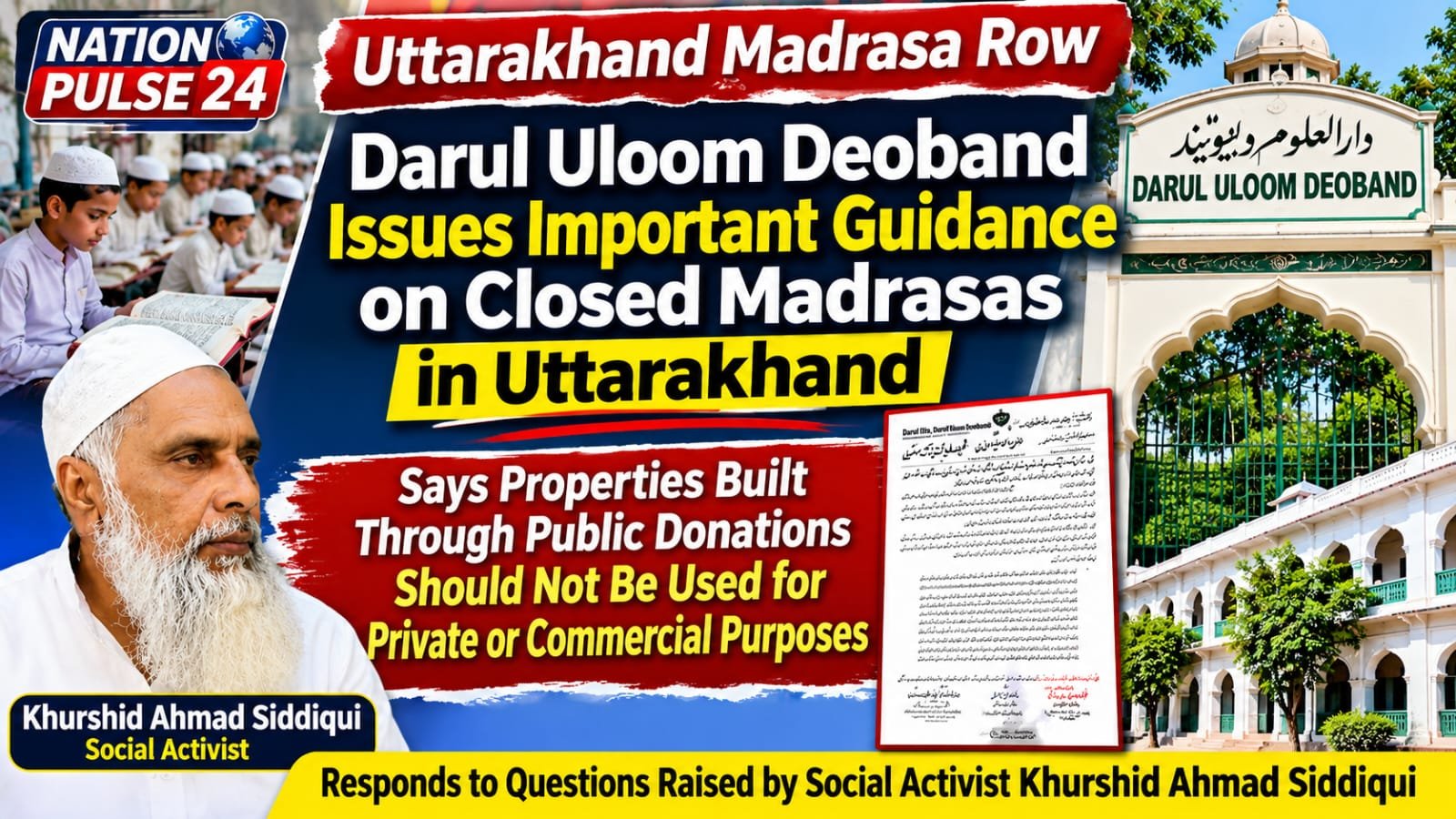
Darul Uloom Deoband Issues Important Guidance on Closed Madrasas in Uttarakhand

Says properties established through public donations for religious education should not be diverted for private or commercial use; responds to questions raised by social activist Khurshid Ahmad Siddiqui
DEHRADUN, UTTARAKHAND: The closure of several madrasas in Uttarakhand following the implementation of new government regulations has raised serious concerns within the Muslim community, particularly over the future of buildings and properties established through public donations for religious education.
With several madrasa managements reportedly discontinuing educational activities under the changed regulatory framework, a significant question has emerged: What will happen to the buildings constructed over the years through public contributions, donations, Zakat and other forms of financial assistance?
In an effort to seek religious clarity on the issue, social activist Khurshid Ahmad Siddiqui approached Darul Ifta of Darul Uloom Deoband, one of the country’s most prominent Islamic institutions, and submitted a series of questions concerning the future and permissible use of properties belonging to closed madrasas.
Darul Ifta issued its written response on September 11, 2026, providing important Islamic guidance on the matter.
The questions primarily concerned whether buildings and land donated or established specifically for religious education could be sold, converted into commercial establishments, used for private purposes or diverted towards activities unrelated to their original objectives after the closure of the institutions.
The response emphasises the importance of respecting the original purpose for which a property was donated or dedicated. Properties specifically endowed for religious education and madrasa activities should continue to be used in accordance with the conditions and objectives of the endowment. The closure of an institution does not automatically give its management the right to use such properties for personal or commercial benefit.
The issue is particularly significant in Uttarakhand, where many madrasa buildings were reportedly constructed through years of public contributions and the financial sacrifices of ordinary families. People donated their hard-earned money, land and construction materials with the expectation that these institutions would provide religious education to future generations.
The guidance from Darul Uloom Deoband has brought renewed attention to the responsibility of protecting these properties and maintaining their intended religious and educational purpose.
It also highlights the need for madrasa managements to explore appropriate ways of continuing religious education within the prevailing legal framework. Where existing arrangements have become difficult due to regulatory restrictions, consultations with qualified Islamic scholars, Muftis and relevant authorities may help identify a suitable alternative.
The response has also opened up a wider discussion about the protection of community-funded religious institutions and the accountability of those entrusted with their management.
Khurshid Ahmad Siddiqui’s initiative is being viewed as significant because it has brought an important issue affecting numerous madrasa buildings and properties before a leading Islamic institution for clarification.
The matter now calls for collective attention from madrasa managements, religious scholars, community organisations and relevant authorities to ensure that properties created through public donations are protected and their original objectives are respected.
For the Muslim community, the issue goes beyond the closure of educational institutions. It concerns the protection of a public religious trust built through the contributions and sacrifices of generations.
The central question remains: If a madrasa closes due to regulatory circumstances, should the educational mission for which its building was established also come to an end?
Leave a Reply