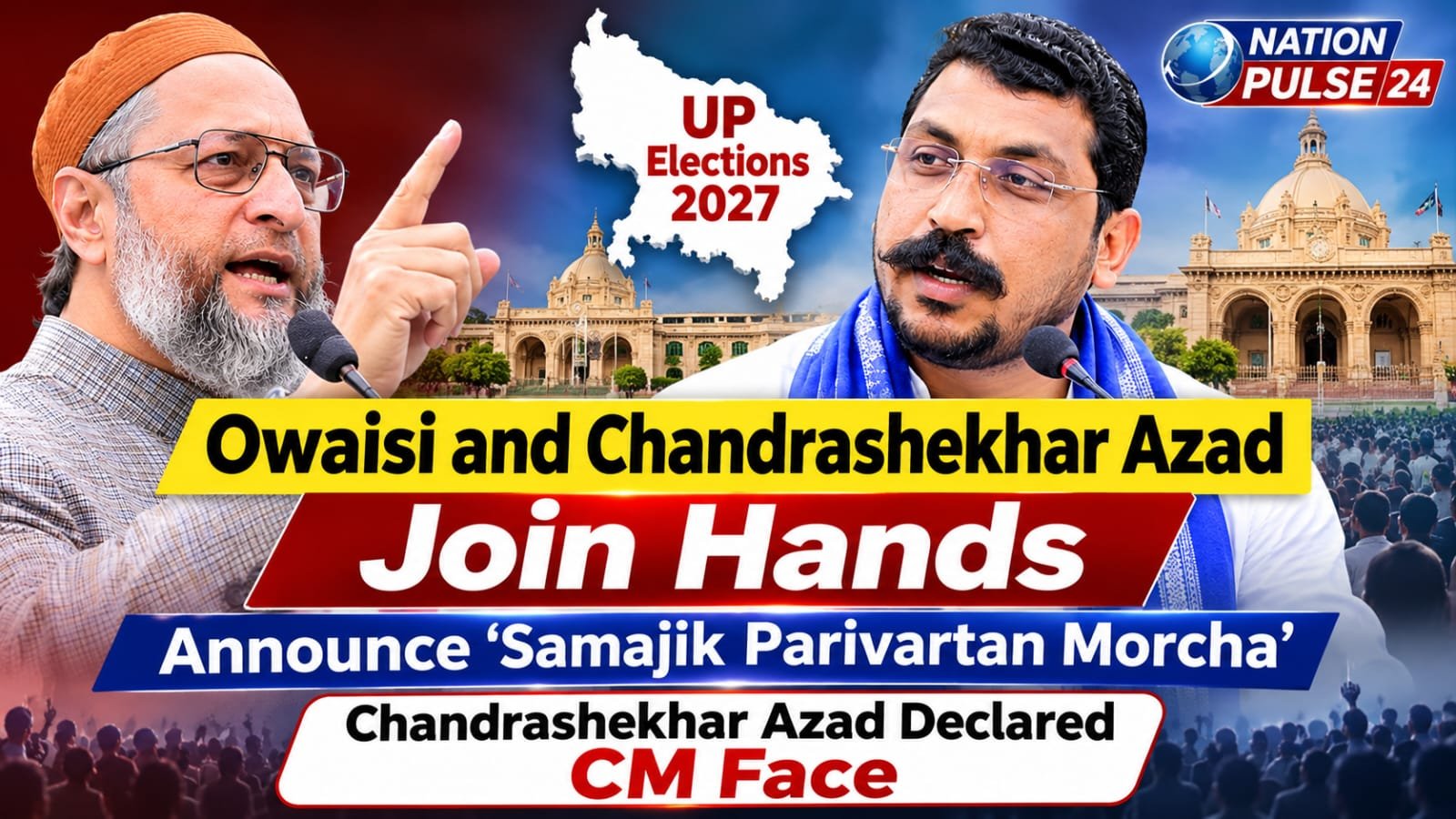
Owaisi and Chandrashekhar Azad Join Hands Ahead of 2027 UP Elections, Announce ‘Samajik Parivartan Morcha’
Chandrashekhar Azad Declared Chief Ministerial Face; Alliance Announces Plans to Contest All 403 Assembly Seats

Lucknow: In a significant political development ahead of the 2027 Uttar Pradesh Assembly elections, All India Majlis-e-Ittehadul Muslimeen (AIMIM) chief Asaduddin Owaisi and Azad Samaj Party (Kanshi Ram) president and Nagina MP Chandrashekhar Azad have announced a new political alliance named ‘Samajik Parivartan Morcha’ (Social Transformation Front).
The two leaders made the announcement during a joint press conference in Lucknow on Thursday, signalling the emergence of a new political combination in the politically crucial state of Uttar Pradesh.
One of the most significant announcements of the press conference was Owaisi’s declaration of Chandrashekhar Azad as the alliance’s Chief Ministerial face for the 2027 Assembly elections. The leaders also announced that the alliance would contest all 403 Assembly constituencies in Uttar Pradesh.
The primary objective of the newly formed front is to bring Dalit and Muslim communities together on a common political platform while raising issues concerning youth, farmers, economically weaker sections and marginalised communities. Both leaders said their political agenda would focus on social justice, equal representation, political participation and the rights of disadvantaged sections of society.
Addressing the press conference, Asaduddin Owaisi described the Samajik Parivartan Morcha as a strong political alternative in Uttar Pradesh. He said the alliance would work to prevent the BJP from returning to power for a third consecutive term in the state.
Owaisi also emphasised farmers’ issues, saying that the alliance would fight for their rights and concerns. Highlighting the importance of political representation for the Muslim community, he remarked that Muslims should no longer be confined to merely arranging chairs and laying carpets at political gatherings. According to him, the community now wants equality, dignity and an equal share in political power.
“Abdul is no longer just laying carpets. Abdul wants equality and equal participation. We stand with him,” Owaisi said, underlining his party’s position on political empowerment and representation.
Chandrashekhar Azad also launched a sharp attack on political parties over their treatment of senior Samajwadi Party leader Azam Khan. Referring to his imprisonment and political circumstances, Azad questioned which political forces were responsible for his situation. He alleged that Azam Khan had been used for electoral gains but that no one had genuinely fought for him when he faced difficulties.
Azad further claimed that atrocities against marginalised communities had increased since 2012. Criticising the state government’s priorities, he alleged that the government was more concerned about the interests of business groups than the problems of ordinary people.
He said that if the Samajik Parivartan Morcha came to power, its government would prioritise quality education, improve the condition of public hospitals and create better employment opportunities for young people.
The announcement of Chandrashekhar Azad as the Chief Ministerial candidate is being viewed as a significant political move, as the alliance has projected its leadership well ahead of the Assembly elections. While Azad has established his political identity through Dalit representation and social justice issues, Owaisi brings AIMIM’s political presence and organisational network among sections of the Muslim electorate.
The alliance’s decision to contest all 403 seats reflects its ambitious electoral strategy. However, its actual political impact will depend on its organisational strength, selection of candidates, regional influence and ability to secure public support across different communities.
The coming months will be crucial in determining whether the new alliance can successfully translate its Dalit-Muslim unity agenda into electoral support. Its impact on the existing political equations involving the BJP, Samajwadi Party, Congress and other regional forces will also remain a key subject of discussion.
With the formation of the Samajik Parivartan Morcha, Uttar Pradesh’s political landscape has acquired a new dimension ahead of the 2027 Assembly elections. Whether the Owaisi-Azad partnership emerges as a decisive political force or faces challenges in converting its electoral ambitions into votes remains to be seen.
Nation Pulse 24 | Political News & Analysis
Leave a Reply