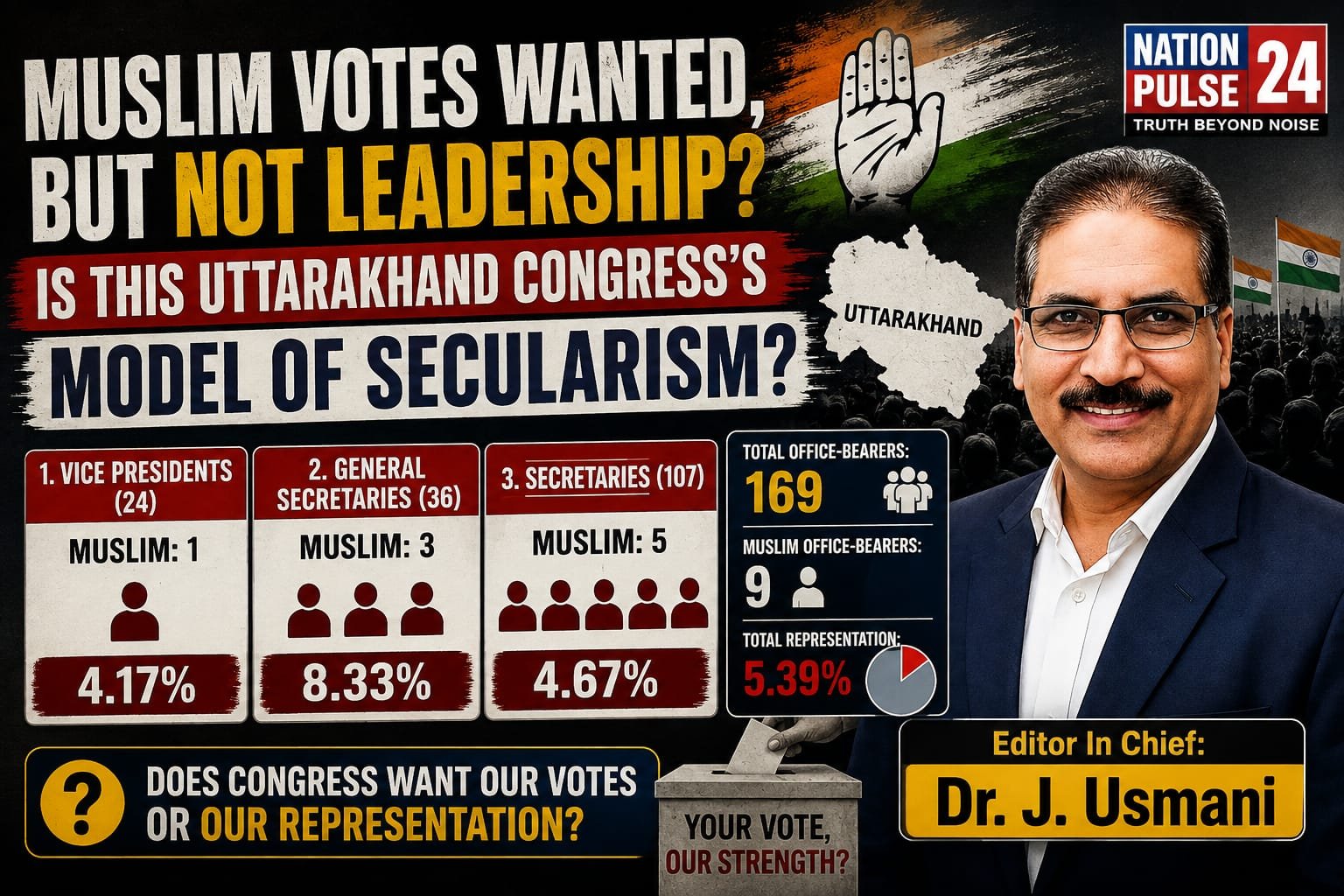
Muslim Votes Wanted, But Not Leadership? Is This Uttarakhand Congress’s Model of Secularism?
Muslim Votes Wanted, But Not Leadership? Is This Uttarakhand Congress’s Model of Secularism?
By Dr. Jamshed Usmani
Senior journalist
The Uttarakhand Congress has finally announced its new Pradesh Congress Committee after a wait of nearly six years.
Coming in an election year, the new organizational structure was expected to reflect the party’s commitment to inclusive and meaningful representation of its core supporters.
But the list has raised a serious political question:
Does the Congress see Muslims as political partners—or merely as a vote bank during elections?
The newly announced organization has 169 office-bearers in total. According to the list, only nine are Muslim, accounting for just 5.39% of the total representation.
That figure itself raises an uncomfortable question for the Congress leadership:
If Muslim voters constitute an important part of the party’s electoral support base in Uttarakhand, why is their representation in the party organization so limited?
A Question From the 2017 and 2022 Elections
The political significance of Muslim voters in Uttarakhand cannot simply be ignored.
In the 2017 and 2022 Assembly elections, Congress candidates performed strongly in several constituencies where Muslim voters have a significant electoral influence. The argument can therefore be made that Muslim support has played an important role in helping the Congress maintain its political presence in the state.
But if this support is politically important during elections, the question is:
Where is the corresponding representation when it comes to power and organizational decision-making?
Congress ruled Uttarakhand for around a decade. Yet, according to the political record cited in this debate, not a single Muslim MLA was included in the state Cabinet during that period.
And now, with the announcement of the new organizational team, the issue of representation has once again come into focus.
The message perceived by many is blunt:
Muslim votes are welcome—but meaningful political representation remains limited.
What Does Secularism Really Mean?
The Congress has repeatedly projected itself as a major political defender of secularism and constitutional values.
But secularism cannot merely be a slogan delivered from political platforms.
It must also be reflected in the structure of political parties themselves.
If a political party speaks about equality, inclusion and constitutional representation, then those principles should be visible not only in speeches, but also in organizational appointments, political leadership and decision-making positions.
This raises a simple question:
If Muslims are an important part of the party’s electoral support base, why does their presence remain so limited in the organization?
The Politics of a “Permanent Vote Bank”
Perhaps the most serious political concern is the perception that Congress continues to operate under an old assumption—that Muslim voters have nowhere else to go.
The assumption appears to be:
Whether Muslims receive respect or face neglect, whether they receive political opportunities or not, they will ultimately vote for Congress because they want to defeat the BJP.
If such thinking exists within the party, it could prove to be one of Congress’s biggest political mistakes.
For decades, so-called secular political parties have appealed to Muslim voters in the name of defeating the BJP.
But a legitimate question remains:
What has the Muslim community received in return?
Equal representation?
Leadership opportunities?
A meaningful role in decision-making?
Or merely election-time appeals and political promises?
If the relationship between a political party and a community is reduced to taking votes while limiting representation, that cannot reasonably be described as genuine political partnership.
It begins to look more like political dependence and electoral calculation.
Representation Is Not a Favour
Congress must understand that political respect also has a political value.
A community that repeatedly turns up at polling stations and supports a political party has every democratic right to ask:
Where is our representation in the organization?
Representation is not a favour.
It is not charity.
And it should not be treated as a reward given only when politically convenient.
If Congress wants to present itself as an inclusive and secular political force, then its organizational structure must reflect that claim.
The Question Congress Cannot Avoid
The issue is not about demanding special treatment for one community.
The question is much simpler:
Has a community that is considered an important part of Congress’s electoral support base received meaningful representation within the party organization?
If the answer is no, then questioning this imbalance is not anti-Congress politics.
It is a legitimate democratic question.
The Congress leadership must now decide whether it wants the Muslim community to be treated as a political partner or merely as an electoral necessity.
Because in a democracy, asking for votes becomes morally meaningful only when a party is also prepared to offer respect, representation and participation.
And the Question for Muslim Voters
The Muslim community must also ask itself a difficult question:
Should unconditional electoral support for any political party continue indefinitely—or should every political party be held accountable for representation, respect and political participation?
A vote is not merely a tool to defeat one political party and elect another.
A vote is also a democratic instrument to demand dignity, representation and accountability.
And perhaps the time has come for every political party in Uttarakhand to answer one fundamental question:
“Do you want our votes—or do you also want us as equal partners in political leadership?”

Related Posts
Dr. Riazul Hasan Siddiqui Appointed Chief Spokesperson of Uttarakhand Minority Congress
OUN Foundation Welcomes Sabri Chadar Procession, Organises Grand Langar on Eid Milad-un-Nabi ﷺ