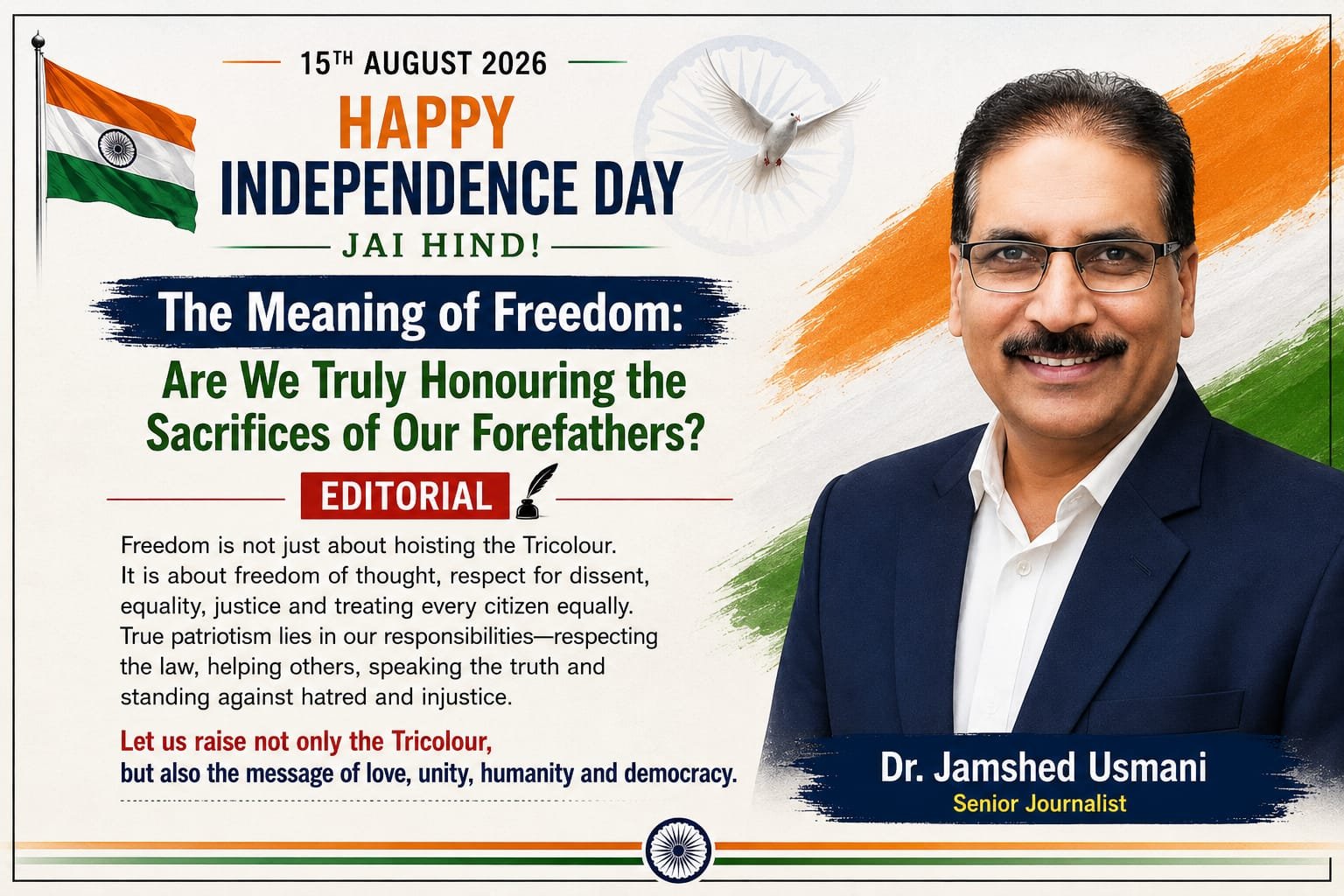
The Meaning of Freedom: Are We Truly Honouring the Sacrifices of Our Forefathers?
The Meaning of Freedom: Are We Truly Honouring the Sacrifices of Our Forefathers?

Dr. Jamshed Usmani
Today, India celebrates its Independence Day with pride, enthusiasm and joy. The Tricolour is flying high, patriotic songs are echoing across the country, schools and institutions are organising programmes, and the spirit of freedom can be felt everywhere.
This is the historic day when India broke the chains of British colonial rule and began its journey as a free and independent nation.
But amid the celebrations, there is a question that every citizen must ask himself and herself:
Are we truly honouring the sacrifices of those who fought for our freedom?
Freedom was not merely about liberating India from British rule. Freedom meant creating a country where every citizen could live with dignity, express an opinion, ask questions, practise their faith, follow their beliefs and enjoy equal rights under the law.
Our forefathers dreamed of an India where a person’s identity would not be determined by caste, religion, language or region, but by the simple fact that they are human.
They went to prisons, faced lathi charges, endured bullets and sacrificed their lives so that future generations could breathe the air of freedom.
But today, when questions are being raised about democratic values, when concerns are expressed over restrictions on freedom of expression, when attempts are made to silence voices of dissent, and when hatred and social divisions based on caste and religion appear to be growing, we must pause and reflect.
Is hoisting the Tricolour alone enough to celebrate Independence Day?
No.
The true meaning of freedom is the freedom of thought, the right to question, respect for dissent, equality before the law and the opportunity to live in a society based on justice and dignity.
If someone holds an opinion different from ours, it does not necessarily make that person our enemy.
The beauty of democracy lies in the fact that people with different opinions can live together as equal citizens of the same nation.
Dissent is not the weakness of democracy; it is one of its strengths.
At a time when hatred, mistrust and divisions in the name of caste and religion are increasingly visible in society, Independence Day should not be merely a day of celebration. It should also be a day of introspection.
We must ask ourselves:
What kind of India do we want to leave for the generations that come after us?
An India where one citizen hates another?
Or an India where people belonging to different faiths—whether they worship in temples, mosques, churches or gurdwaras—stand together in each other’s moments of happiness and sorrow?
Let us remember:
True patriotism lies in bringing people together, not in dividing them.
If we see something wrong in our society or in the system, we must certainly raise our voice against it—but not through violence, abuse or hatred.
The path of protest should be democratic, peaceful and constructive.
Ask questions. Present your arguments. Raise your voice within the framework of the Constitution and the law. And work towards meaningful change.
Because patriotism is not limited to slogans.
Patriotism is about fulfilling our responsibilities.
Respecting the law is patriotism.
Helping those in need is patriotism.
Having the courage to speak the truth against injustice is patriotism.
Respecting the rights of others is patriotism.
And above all, treating every citizen of the country equally is patriotism.
Democracy becomes stronger when citizens, along with governments and institutions, understand their responsibilities.
We must not only demand our own rights; we must also respect the rights and freedoms of others.
Independence Day reminds us that the greatest strength of India is not merely the Tricolour, but also our unity, democracy and spirit of brotherhood.
If democratic values face challenges today, there is no reason for us to lose hope. Instead, this is the moment to strengthen once again the values upon which our free India was built.
On this Independence Day, let us not merely hoist the Tricolour outside our homes and institutions.
Let us also raise the flag of love in our hearts, humanity in our conduct and democracy in our thinking.
Let us pledge that we will not allow politics of hatred to become normal.
We will not allow walls to be built between human beings in the name of caste or religion.
We will not treat disagreement as enmity.
We will protect the right to speak the truth and ask questions.
And wherever we see discrimination or injustice, we will stand against it through peaceful and democratic means.
Because freedom is not merely a date—15 August 1947. Freedom is a responsibility, an idea and a trust that we owe to future generations.
Therefore, on this Independence Day, the most important question before us is:
We achieved freedom—but are we truly preserving the meaning of freedom?
If our forefathers sacrificed their lives for an India built on equality, brotherhood and justice, then the greatest tribute we can offer them is to strengthen the India they dreamed of.
An India where there is more love than hatred.
More trust than fear.
More equality than discrimination.
More humanity than divisions of caste and religion.
And an India where democracy is not merely written in books, but is visible in our behaviour, our institutions and our everyday lives.
This Independence Day, let us raise not only the Tricolour, but also the message of love, unity, humanity and democracy with all our hearts.
Jai Hind.

Related Posts
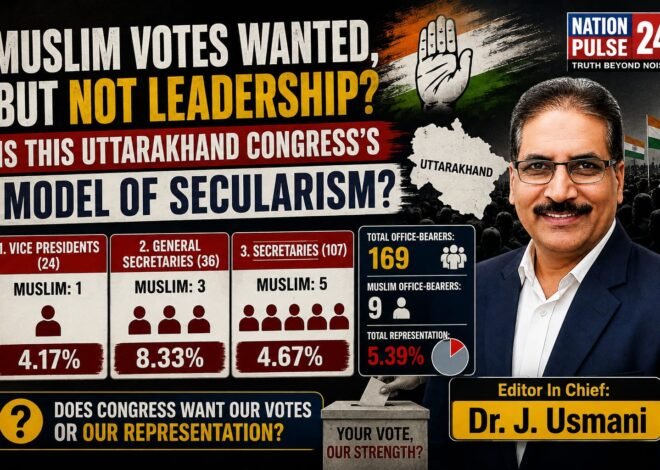
Muslim Votes Wanted, But Not Leadership? Is This Uttarakhand Congress’s Model of Secularism?

Uttarakhand Muslims Send a Clear Political Message: Our Vote Will No Longer Be About Defeating Someone, But About Securing Our Future