India Unveils Indigenous Semiconductor Breakthroughs at Semicon India 2025
India Unveils Indigenous Semiconductor Breakthroughs at Semicon India 2025

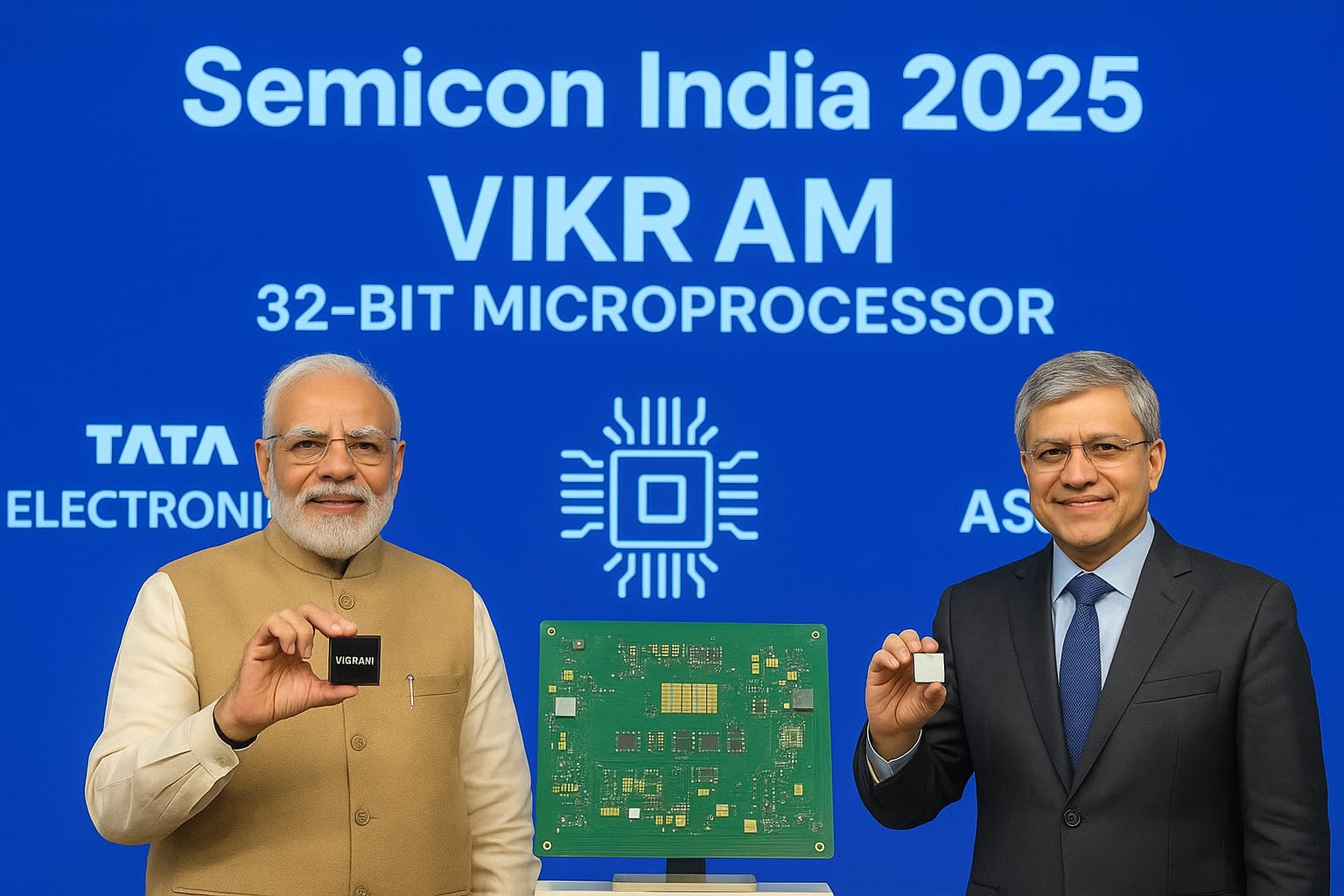
In a historic step towards technological self-reliance, India showcased two major semiconductor innovations at the Semicon India 2025 event. Prime Minister Narendra Modi and Union Electronics & IT Minister Ashwini Vaishnaw unveiled the country’s first fully indigenous 32-bit microprocessor, “Vikram,” along with semiconductor chips developed in Assam.
The Vikram processor marks a crucial milestone in India’s ambition to become a global leader in semiconductor design and manufacturing. Developed entirely within the country, the 32-bit chip is expected to power a wide range of applications, from consumer electronics to industrial systems. Minister Vaishnaw highlighted that this processor symbolizes India’s entry into the league of nations capable of building advanced microchips independently.
At the same event, Tata Electronics’ Jagiroad facility in Assam presented the Tata OSAT chip. Designed for packaging, testing, and optimization, this innovation enables mass-scale semiconductor production. In parallel, NIT Silchar unveiled a Neural Amplifier Frontend IC, developed to support brain-computer interfaces and medical technologies by enhancing low-noise neural signal amplification.
Experts say these developments not only reduce dependence on global supply chains but also create opportunities for domestic startups and research institutions. The Assam chips, in particular, are being seen as a signal of India’s intent to expand semiconductor manufacturing beyond traditional hubs, promoting regional innovation.
Prime Minister Modi called the unveiling a “turning point in India’s semiconductor journey,” stressing that the government’s support for R&D and private investment will accelerate the country’s growth as a global tech hub.
With global semiconductor demand projected to surge, India’s latest achievements could position it as a significant player in the industry, bridging the gap between innovation and large-scale manufacturing.