
Indian Engineers Drive eVTOL Innovation, Paving the Way for Air Taxis and Air Ambulances
Indian Engineers Drive eVTOL Innovation, Paving the Way for Air Taxis and Air Ambulances
Report by: Syed Taskin Ahmed
New Delhi, September 10, 2025 – India is fast emerging as a hub for advanced air mobility as homegrown engineers and startups step up efforts in developing electric vertical take-off and landing (eVTOL) aircraft. These next-generation flying vehicles, capable of operating as air taxis and air ambulances, are expected to redefine urban transportation in the coming years.
Engineers at the Forefront
Indian engineers are contributing significantly to the global eVTOL ecosystem, working on navigation software, flight control systems, and battery technology to ensure safe and efficient operations. Their expertise is being tapped by both domestic startups and international collaborations.
Startups Leading the Charge
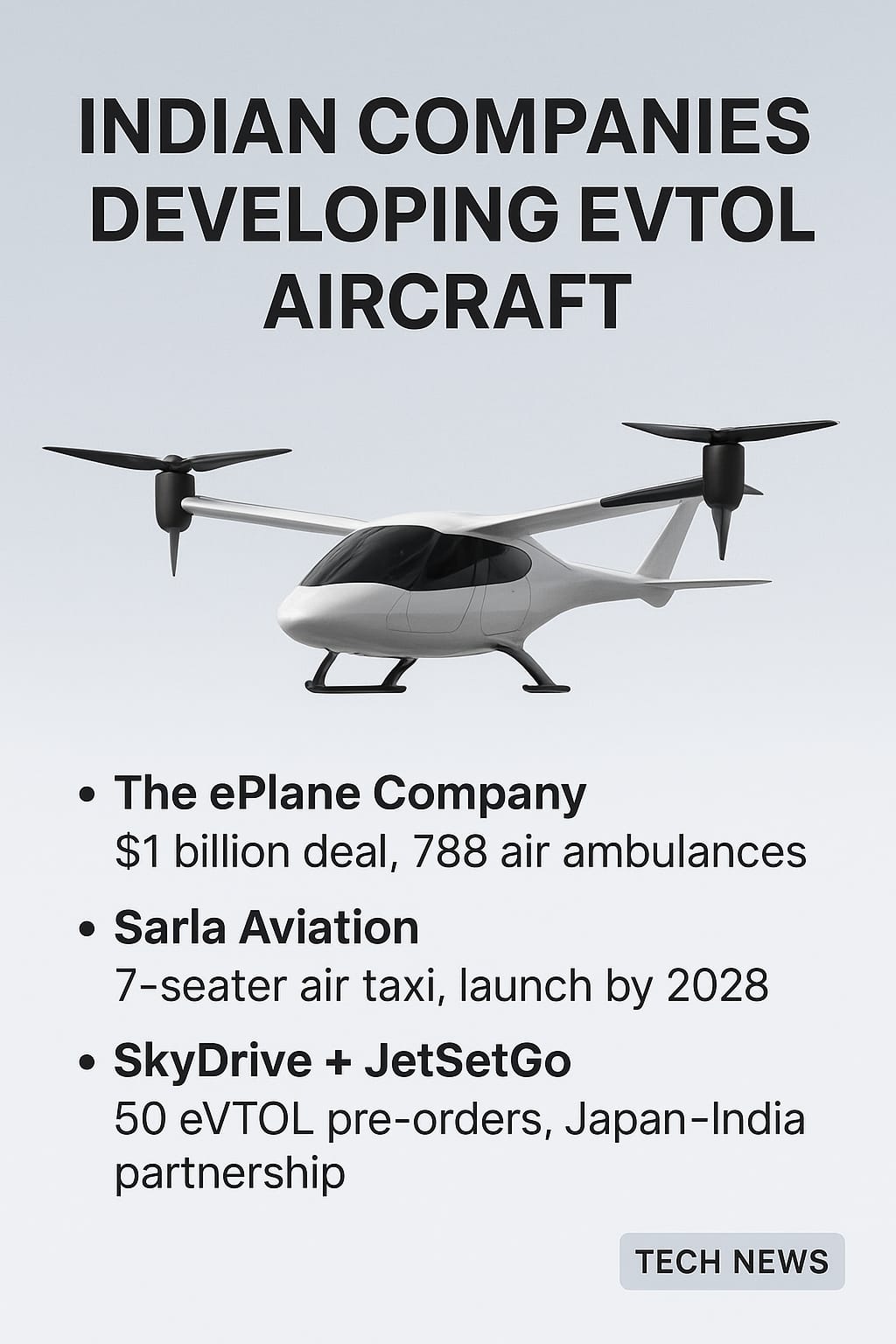
The ePlane Company (Chennai) has secured over $20 million in funding and recently signed a $1 billion agreement to supply 788 eVTOL air ambulances across India. A certifiable prototype is expected by March 2025, with commercial rollout targeted for late 2026.
Sarla Aviation (Bengaluru) is developing a seven-seater eVTOL prototype with a range of up to 160 km. Backed by $10 million in funding, the company plans to launch operations by 2028 and is working with Makmor to establish a network of vertiports across Indian metros.
In a Japan–India partnership, SkyDrive has joined hands with private jet operator JetSetGo, with a pre-order of 50 aircraft. The collaboration also involves Indian engineering major Cyient, marking a major step in technology co-development.
Infrastructure Support
The Maharashtra government has also announced plans to build vertiports across districts to support future air taxi services. Cities like Nagpur and Pune are expected to be among the early adopters of this infrastructure.
A Billion-Dollar Opportunity
Industry experts believe India could become one of the largest markets for eVTOL technology, thanks to its dense urban centers, traffic congestion issues, and rising demand for faster medical evacuation services. With both domestic innovation and international collaboration, India is well-positioned to be a leader in advanced air mobility by the end of this decade.