Banking and Finance System, *Challenges and Opportunities for Muslim Businesses*
Banking and Finance System, *Challenges and Opportunities for Muslim Businesses*
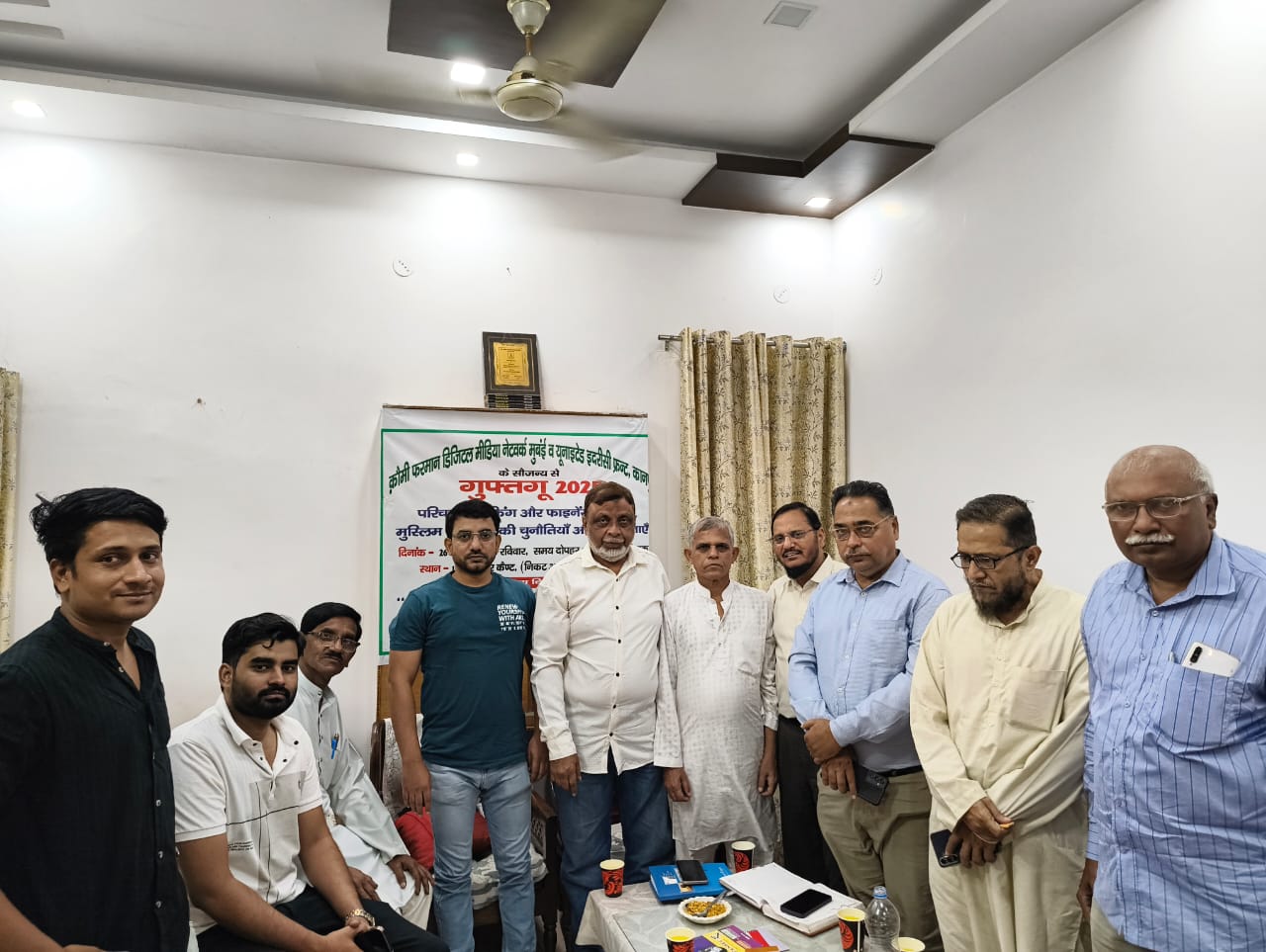
Kanpur: October 26 – An important discussion on “Banking and Finance System, Challenges and Opportunities for Muslim Businesses” was held today in the city’s Mirpur Cantonment under the leadership of Abdul Hameed Idrisi. The program aimed to increase banking and financial awareness among the Muslim community, develop an understanding of financial options in accordance with Sharia principles, and explore paths to business growth.
Many experienced individuals from the banking sector, academia, and the business community participated in the discussion. During the discussion, it became clear that lack of awareness about the banking system remains a major problem among the Muslim community. Many people remain disconnected from the banking system, preventing them from taking advantage of government schemes, credit facilities, and modern financial opportunities. Speakers emphasized that if the Muslim community is to be economically empowered, they must first increase their participation in the banking and finance sector.
Chairing the event, Abdul Hameed Idrisi Sahib, National Vice President of the United Idrisi Front, a retired officer from PNB Bank, said, “Banking is essential for the Muslim community to become economically strong. Until our capital is integrated into the banking system, we will remain excluded from the mainstream of development.” He emphasized that now is the time for concrete action, not just discussion.
Aftab Sahib, a retired manager from PNB Bank, said, “The issue of interest (riba) requires a religious debate, as well as practical solutions. By understanding the principles of Islamic financing, such as murabaha, ijara, and mudaraba, in the Indian context, alternative and ethical financial models can be developed.”
Liaqat Sahib, a retired PNB Bank employee, said, “Today, banking has become completely transparent and technological. If Muslim businesses adopt digital payments, current accounts, and tax compliance, they can progress economically much faster.”
During the discussion, Chartered Accountant Shahid Kamran, citing the examples of the Parate Ground and the Qureshi community, said, “Earlier, when slips were issued for five to ten rupees, people started shying away from them. This mental distance has become the biggest obstacle. Unless the Muslim community takes the initiative to integrate itself into the documentation system and formal financial processes, it will not be able to establish a strong presence in the banking sector.” He added that staying away from banking is not just a financial loss, but also akin to being cut off from the mainstream of development.
Aziz Sahib, a retired lecturer in the Commerce Department of Halim College, shared his views, saying, “Taking financial education and financial literacy to the grassroots level is the need of the hour. Only when young people have a basic understanding of banking and finance will they be able to become self-reliant.”
At the end of the program, the editor of Qaumi Farman, taking note of the suggestions made in the discussion, said, “Now we need action, not just talk. We must develop a collective action plan.” Taking responsibility, he said he would develop a concrete action plan to advance this idea, including programs such as financial awareness camps, banking counseling, MSME and digital finance training.
Mushir Alam, Tariq Hashmi, Saad Khan, and Asif Khan also expressed their views at the meeting. The discussion concluded with the hope that this initiative, which began in Kanpur, would grow into a comprehensive socio-economic campaign. Participants pledged to play an active role in promoting financial literacy, banking engagement, and business development in the community.
