



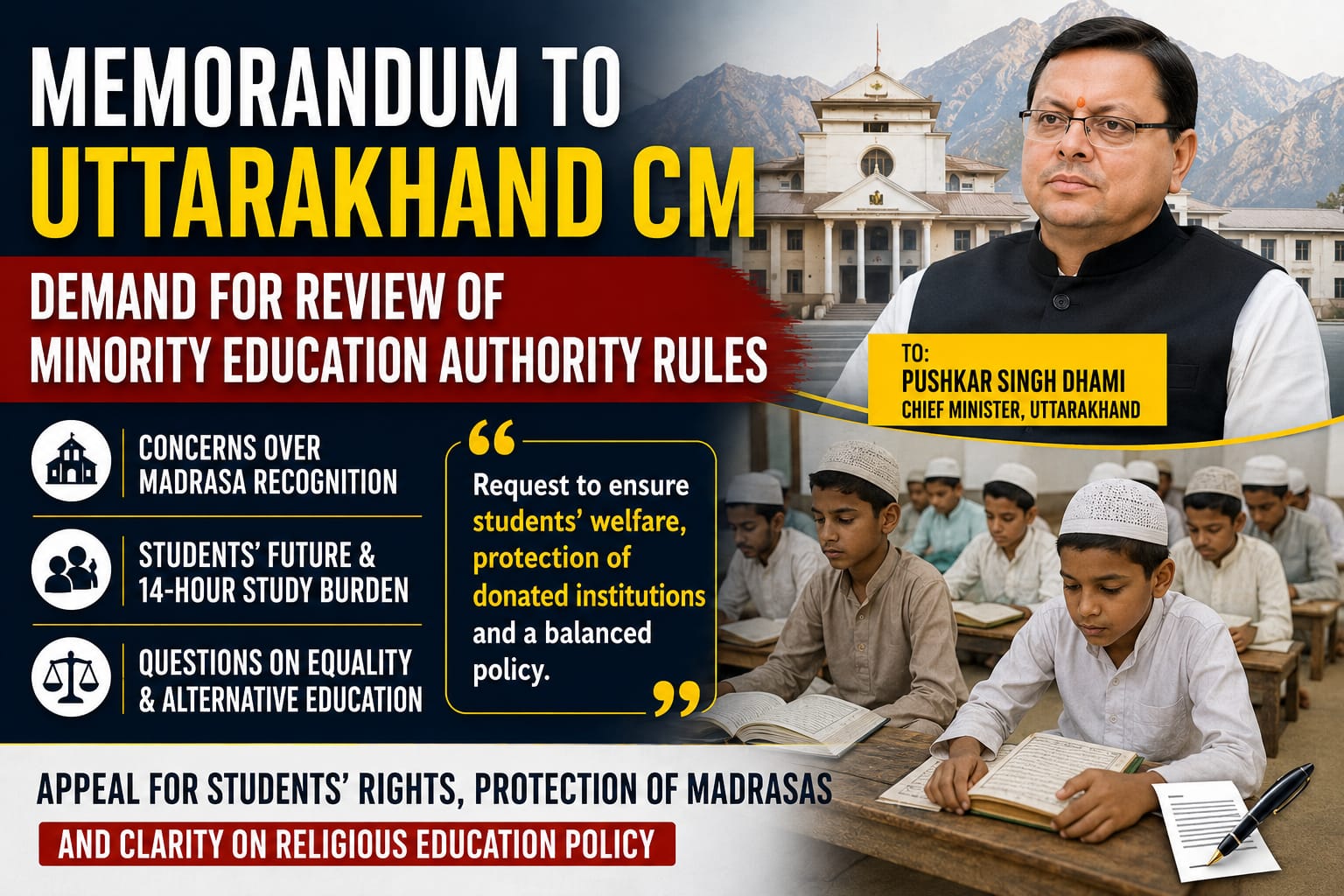
Call for Review of Uttarakhand Minority Education Authority Rules; Memorandum Submitted to Chief Minister
Khursheed Ahmad Siddiqui raises concerns over madrasa recognition, students’ future, and religious education, urges the government to adopt a clear and balanced policy.
Report: Amaanullah Usmani
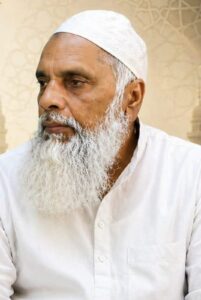
Dehradun: Social worker Khursheed Ahmad Siddiqui has submitted a detailed memorandum via email to Uttarakhand Chief Minister Pushkar Singh Dhami, urging the state government to reconsider the provisions of the newly implemented Uttarakhand Minority Education Authority framework, which came into effect on July 1, 2026. Copies of the memorandum have also been sent to the Chief Secretary of Uttarakhand and the Chairman of the Uttarakhand Minority Education Authority.
In his memorandum, Siddiqui stated that madrasas are not merely educational institutions but religious and social establishments built and maintained through donations, charity, and Zakat contributed by the Muslim community. Referring to a recent statement by Maulana Arshad Madani, he noted that, from an Islamic perspective, mosques and madrasas hold comparable religious significance and are governed by similar religious principles.
The memorandum points out that the state currently recognizes only 452 madrasas that were previously registered with the Uttarakhand Madrasa Board, while nearly 250 others are reportedly being treated as unauthorized. Siddiqui expressed concern that the fresh registration process and compliance with new regulatory standards may prove difficult for many institutions, potentially leading to their closure.
He suggested that the 452 previously registered madrasas should be granted automatic recognition so that the ongoing academic session and students’ education are not disrupted.
The memorandum also raises concerns about the academic burden on students. According to Siddiqui, if madrasa students are required to attend regular schools while continuing their religious studies, they may have to study for nearly 14 hours a day. He questioned whether such a schedule would be practical or beneficial for children between the ages of 4 and 16, and whether it could adversely affect their physical and mental development.
The memorandum further asks whether similar arrangements are being applied to the religious educational institutions of other minority communities, including Buddhist monasteries, Bible schools, Sikh, and Jain religious institutions, or whether the policy is being implemented exclusively for Muslim madrasas.
Siddiqui has sought clarity from the government on several issues, including the future of madrasas that may fail to meet the prescribed standards, alternative arrangements for students pursuing religious education, educational pathways for students wishing to pursue advanced Islamic studies after completing Hifz-e-Quran, the financial implications of the new system, and the government’s plans regarding qualified teachers and institutional funding.
Concluding the memorandum, Siddiqui appealed to Chief Minister Pushkar Singh Dhami to review the law in the interest of students’ educational and psychological well-being. He also urged the government to ensure the protection of madrasa properties established through public donations, so that such institutions do not become entangled in unnecessary disputes or litigation.